

The discovery of the Cave

The discovery of the Cuevas del Aguila (Eagle Caves) happened by chance on the afternoon of December 24th, 1963. Five young men exploring Cerro de Romperropas, also known as Cerro del Aguila, were surprised to see steam rising from a hole. This steam was caused by the temperature difference between the cave’s interior, around 17°C, and the cold air outside.

With ropes and flashlights, these young men ventured into what appeared to be a small opening, barely 60 cm in diameter. They climbed down for a while and crawled some 50 to 60 meters until they reached the large main chamber. However, they were lost inside the cave for almost five hours, until they finally managed to find the opening through which they had entered again.

After this discovery, the authorities, the owners of the estate, and experts were informed of the great finding. After extensive renovation work, the Cuevas del Aguila has been open to the public every day of the year since July 18th, 1964.
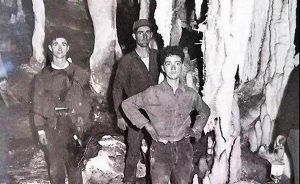

An amazing discovery

Underground Formations

Caves are karst cavities shaped over millennia by geological processes, such as rainwater seepage and groundwater currents. Once their function as subterranean conduits has ceased, the slow seepage of surface water, rich in CO2, dissolves the calcium carbonate, giving rise to formations such as stalactites, stalagmites, gours, flows, and eccentrics, among other speleothems. It is estimated that these formations grow only one centimeter every 150 years.

ANCESTRAL FORMATION

The cave formation is composed of Paleozoic limestones attributed to the Lower Cambrian. So what does this mean? It means that they were formed between 500 and 540 million years ago. Just imagine, they developed when invertebrates such as Trilobites were the dominant species on earth.

GROUND FRACTURE

At some point thousands of years ago, the ground gave way a few centimeters, causing numerous columns to break, many of which have a flat separation between the two pieces at mid-height.